Playful poetry of openness borne at night | Jon M. Sweeney
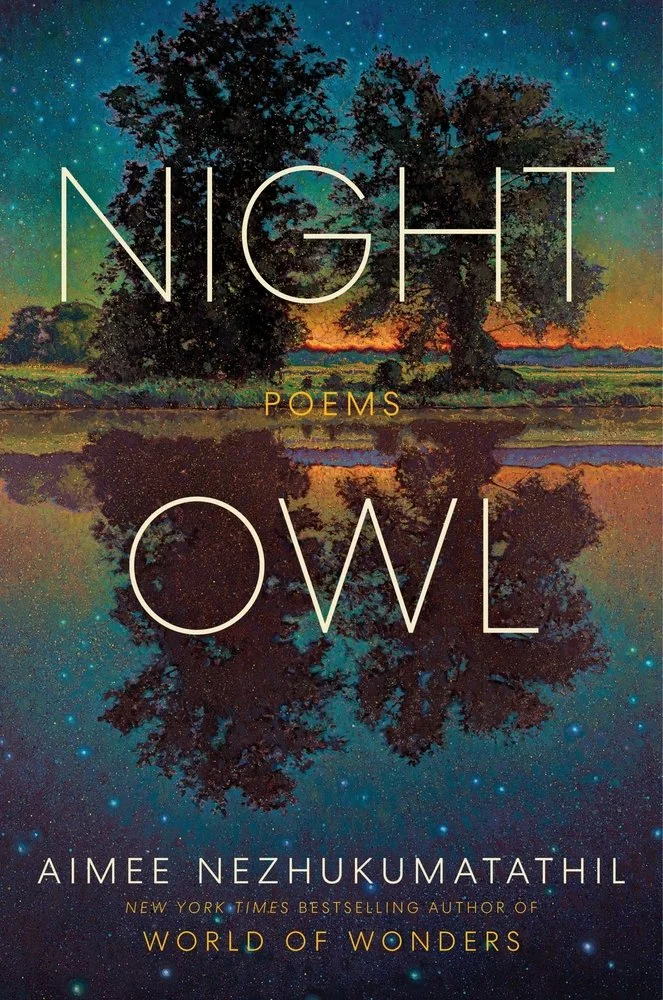
We don’t often review books of poetry, but this one is special. I found the spiritual practices of connections, openness, and play in these joyfully curious poems.
Aimee Nezhukumatathil is an Asian-American poet and professor (currently at University of Mississippi, previously SUNY Fredonia) of English and creative writing. She also has deep interest in environmental literature, which she has taught in the past. Her poems are always full of discovery of and with critters, creatures, and phenomena.
You may recognize her name from a 2020 New York Times best-seller she wrote, illustrated by Fumi Nakamura, called World of Wonders: In Praise of Fireflies, Whale Sharks, and Other Astonishments.
The poems in this collection were borne at night, when the poet tells us she comes out to play and listens most intently. She is listening to, and learning from, what darkness offers. One poem begins, “I never feared the dark. I welcomed it, let it rush / into my unbuttoned blouse. When I was a girl.”
Nezhukumatathil learns from bumble bees, sunburns, hummingbirds, and jellyfish, in these fun verses. She speaks of “Night as a Verb” and in that poem are the lines: “…Let me night like a flower / under the moon, moved to night / my petals—only when the sun nights.”
Childhood is a frequent theme. The childhood of her children, recently, and her own childhood remembered, as when these two poems are offered on facing pages: “What Do You Want to Be When You Grow Up? (Daytime)” followed by “What Do You Want to Be When You Grow Up? (Nighttime).” A dry list in the first poem starts with “Doctor / Attorney / Attorney for doctors.” The second poem is two words: “A writer.”
The message? See what happens at night when you are free of other’s expectations, because, the poet says, “Sometimes I think people forget we glow some of us only show our full / color at night like mushrooms like fireflies.”
Several of the poems are what are called “concrete” or “shape” poems, meaning the words, typography, and remaining white space between words creates a shape or visual image. One of these, called “Big Night,” is a spiral. Another, much more startling, called “Discovery in the Dark,” forms a jungle cat; and “Space Jellyfish: A Parable” even manages to look like a jellyfish. These don’t all fit the nighttime theme, but they are all enjoyable and thought-provoking.
Jon M. Sweeney is an independent scholar and one of religion's most respected writers. His work has been hailed by everyone from PBS and James Martin, S.J., to Fox News and Dan Savage. Sweeney writes regularly for America and The Tablet, and is the publisher and editor-in-chief at Paraclete Press. His latest book is Experiencing God: 36 Ways According to Saint Francis of Assisi (Monkfish Press, 2026).
This review first appeared on Spirituality & Practice: Resources for Spiritual Journeys.